 +916265011977
  support@moolmaati.in
The Story of Patangarh: Birthplace of Contemporary Gond Art

A Small Village with a Global Artistic Legacy
Nestled amidst the forests and hills of Madhya Pradesh, Patangarh is a modest tribal village that has become synonymous with one of India’s most celebrated indigenous art forms—Gond Art. What was once a remote settlement inhabited by the Pardhan Gond community is today recognized across the world as the birthplace of contemporary Gond painting.
Patangarh’s journey from a quiet tribal village to an internationally acclaimed center of artistic excellence is a story of creativity, cultural resilience, and the power of storytelling.
The Roots of Gond Artistic Tradition
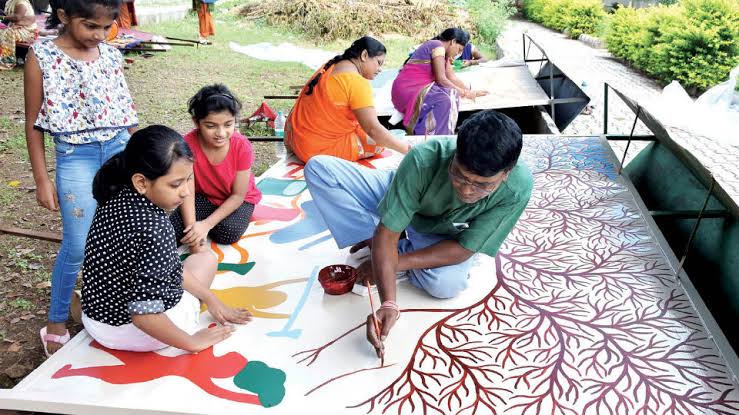
For centuries, the Gond people have expressed their beliefs, folklore, and connection with nature through visual art. Traditionally, these artworks adorned the walls and floors of homes during festivals, weddings, and other important occasions.
The paintings were not merely decorative; they carried stories of ancestors, sacred animals, forest spirits, and the natural world. Every line, dot, and pattern reflected the Gond community’s deep respect for nature and their understanding of life as an interconnected system.
Art was woven into everyday life, passed from one generation to the next through oral traditions and cultural practices.
The Rise of Contemporary Gond Art
The story of modern Gond art cannot be told without mentioning Jangarh Singh Shyam, a visionary artist born in Patangarh.
In the early 1980s, Jangarh Singh Shyam was discovered by artist and cultural activist Jagdish Swaminathan during a visit to the village. Recognizing his extraordinary talent, Swaminathan invited him to work at Bharat Bhavan in Bhopal.
This opportunity transformed not only Jangarh’s life but also the future of Gond art itself.
Moving beyond traditional wall paintings, Jangarh began creating artworks on paper and canvas. He developed a distinctive visual language characterized by intricate patterns, flowing lines, vibrant colors, and imaginative representations of animals, trees, spirits, and mythical beings.
His innovative style came to be known as Jangarh Kalam, a movement that laid the foundation for contemporary Gond art.
A Village of Artists
Inspired by Jangarh’s success, many artists from Patangarh began exploring painting as a profession. Families, relatives, and younger generations embraced the art form, transforming the village into a thriving artistic community.
Today, Patangarh is home to numerous nationally and internationally recognized artists whose works are displayed in galleries, museums, and private collections around the world.
Despite global recognition, the artists remain deeply connected to their cultural roots. Their paintings continue to celebrate tribal stories, local traditions, and the rich biodiversity of central India.
Nature as a Living Inspiration
One of the most distinctive features of Gond art is its intimate relationship with nature.
Animals, birds, trees, rivers, mountains, and celestial elements frequently appear in Gond paintings. Rather than depicting nature as a backdrop, artists portray it as a living presence filled with spirit and meaning.
The intricate patterns used in Gond art often symbolize movement, energy, growth, and the interconnectedness of all living things. Through these visual narratives, artists communicate a worldview where humans and nature coexist in harmony.
Preserving Culture Through Art
For the people of Patangarh, art serves as more than a source of livelihood. It is a means of preserving history, identity, and collective memory.
As modernization continues to reshape rural communities, Gond artists play a vital role in keeping traditional knowledge alive. Their work ensures that stories, beliefs, and cultural practices are passed on to future generations while reaching audiences far beyond their village.
Each painting becomes a bridge between the past and the present, connecting ancient traditions with contemporary artistic expression.
Patangarh’s Global Impact
Today, Patangarh stands as a symbol of how indigenous creativity can transcend geographical boundaries. The village has inspired scholars, collectors, art enthusiasts, and cultural institutions worldwide.
Its artists have demonstrated that tribal art is not merely a relic of the past but a vibrant and evolving form of contemporary expression.
The success of Patangarh has also encouraged greater appreciation for India’s indigenous communities and their invaluable contributions to the country’s cultural heritage.
Conclusion
The story of Patangarh is a story of transformation, resilience, and artistic excellence. From traditional village murals to internationally acclaimed masterpieces, the artists of Patangarh have carried their cultural heritage onto the global stage without losing sight of their roots.
Their work reminds us that art is more than aesthetics—it is memory, identity, and a celebration of the deep bond between people, culture, and nature.
As the birthplace of contemporary Gond art, Patangarh continues to inspire generations of artists and art lovers around the world, ensuring that the rich legacy of the Gond community remains vibrant for years to come.